
Imagine your rolling mill is running at full capacity. Then, without warning, raw material prices spike. Your inventory data is outdated. Three production orders are delayed because no one knows which coils are available. Your dispatch team is managing shipments on spreadsheets. Sound familiar?
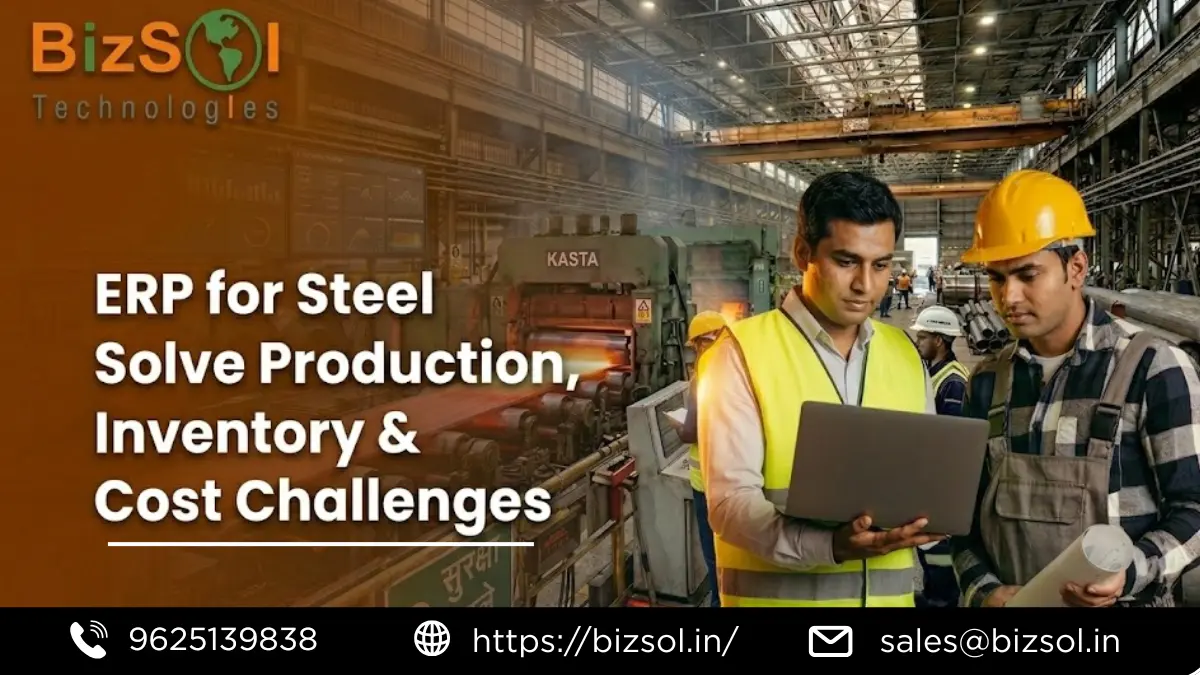
Managing operations without a proper ERP for steel industry often leads to delays, material loss, and poor decision-making. Modern manufacturers are already moving towards advanced manufacturing ERP software to streamline production, reduce waste, and gain real-time visibility across operations.
This is the daily reality for thousands of steel manufacturers. And it’s costing them lakhs every week. The good news? ERP for steel industry is built to fix exactly this. In this guide, you’ll learn what ERP does for steel plants, how it solves real challenges, and how to pick the right system in 2026.
What is ERP for Steel Industry?
ERP for steel industry is a specialized software system that connects production, inventory, procurement, quality control, and finance into one unified platform. It helps steel manufacturers track operations in real time, reduce material loss, and improve production efficiency.
In simple terms, it replaces spreadsheets and manual tracking with a centralized system built specifically for steel plant operations.
If you’re new to ERP systems, understanding why ERP is important for modern businesses will help you see how it improves efficiency, reduces errors, and supports long-term business growth.
Unlike generic ERP systems, a steel-specific ERP understands your processes: rolling mill scheduling, heat number tracking, pipe and tube specifications, scrap management, and grade-wise inventory. It’s built for the shop floor, not just the office.
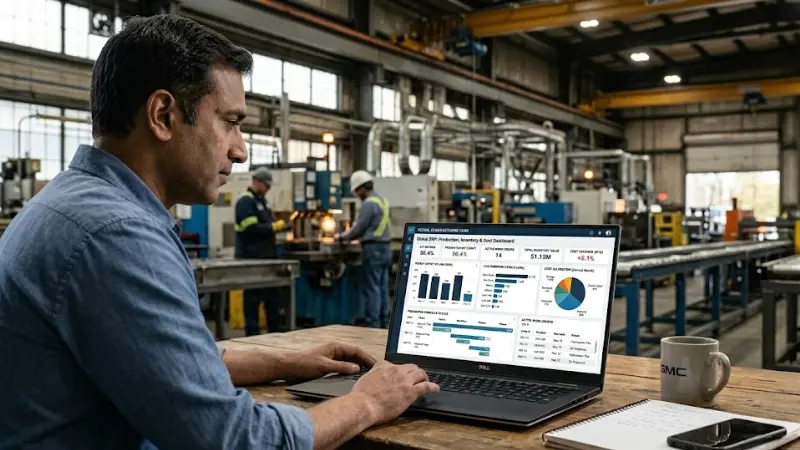
Key Challenges in Steel Industry That ERP Solves
- Raw Material Price Volatility
Steel plants depend on iron ore, scrap, and billets — all of which fluctuate daily. Without a system to track procurement costs in real time, margins shrink before you even notice. - Multi-Stage Production Complexity
Steel goes through melting, casting, rolling, and finishing each stage dependent on the last. A delay at one stage stalls the entire line. - Inventory and Scrap Management
Steel inventory isn’t simple. You’re tracking coils, billets, pipes, tubes, and generated scrap all in different grades, sizes, and heats. Errors here lead to material loss and order mismatches. - Production Delays and Downtime
Unplanned machine stoppages, maintenance gaps, and poor scheduling lead to missed delivery dates and unhappy customers. - Quality Control Across Grades
Different customers demand different grades and tolerances. Tracking test certificates, rejection rates, and rework manually is error-prone. - Order and Dispatch Complexity
Managing customer orders across sizes, grades, and delivery schedules — while handling partial shipments and weight-based billing — requires more than a spreadsheet.
How ERP for Steel Industry Solves These Challenges
| Challenge | ERP Solution | Outcome |
| Raw material price volatility | Real-time procurement tracking with price alerts | Better cost control and margin protection |
| Multi-stage production complexity | Stage-wise production planning and work orders | Reduced idle time, smooth flow |
| Inventory & scrap management | Heat-wise, grade-wise, size-wise inventory tracking | Zero material loss, accurate stock levels |
| Production delays & downtime | Preventive maintenance scheduling and alerts | Higher equipment uptime |
| Quality control across grades | Integrated QC with test reports and rejection logs | Fewer customer complaints, fewer returns |
| Order & dispatch complexity | Order management with weight-based billing | Faster dispatch, accurate invoicing |
Core Features of ERP for Steel Manufacturing Industry
A strong ERP for steel manufacturing industry covers every department in your plant. Here are the must-have features to look for:
● Production Planning: Schedule rolling mill runs, manage work orders, and track output against targets in real time.
● Inventory Management: Track raw materials, WIP, and finished goods by heat number, grade, size, and location.
● Quality Control: Record test parameters, issue certificates, log rejections, and manage rework workflows.
● Procurement & Vendor Management: Compare quotes, issue POs, and track deliveries and payments.
● Sales & Order Management: Handle customer orders, delivery schedules, and weight-based or piece-based billing.
● Finance & Costing: Track cost per heat, per tonne, and per order with full P&L visibility.
● Scrap Management: Log, value, and account for scrap generated at each production stage.
● Dispatch & Logistics: Create challans, manage loading, and update customers with delivery status.
Steel Manufacturing Process + ERP Integration
One of the biggest strengths of ERP software for steel industry is how it connects every stage of your production process. Here’s how it works across the steel manufacturing flow:
Raw Material Intake→Melting / Induction Furnace→Casting / Billet Making→Rolling Mill→Finishing / Cutting→Quality Check→Dispatch
At each stage, the ERP:
● Captures real-time production data (tonnage produced, yield, scrap generated).
● Updates inventory levels automatically when material moves between stages.
● Triggers quality inspections and records test results against heat numbers.
● Alerts supervisors when output falls below target or material goes below minimum stock.
● Links finished goods to customer orders for accurate, on-time dispatch.
● With rolling mill ERP integration, your plant runs like a single connected system — not a collection of disconnected departments.
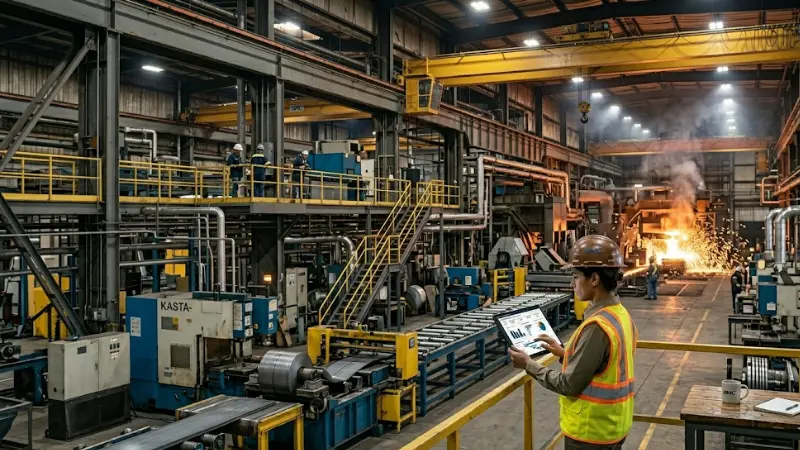
Real-Life Use Cases of ERP in Steel Industry
Let’s look at how erp steel industry implementations solve real problems across three common manufacturing setups.
Problem — Pipe Manufacturing Unit
A pipe manufacturer was losing 12–15% of its material to untracked scrap and incorrect inventory counts. Sales team couldn’t confirm stock availability to customers instantly.
ERP Solution — Pipe Manufacturing ERP
Implemented pipe manufacturing ERP with size-wise and grade-wise stock tracking. Scrap generated during pipe cutting is now logged at machine level and valued automatically.
Result
Material loss dropped by 10%. Sales team can now confirm stock in seconds. Billing accuracy improved by 18%.
Problem — Tube Industry Plant
A tube manufacturer was managing 40+ customer grades across ERW and seamless categories. Test certificates were issued manually, causing errors and delays in export shipments.
ERP Solution — Tube Industry ERP
ERP automated test certificate generation linked to each heat and order. Grade-wise quality parameters set once and applied across all orders of the same specification.
Result
Certificate errors dropped to near zero. Export clearance time reduced by 30%. Customer satisfaction scores improved significantly.
Problem — Rolling Mill
A rolling mill had no visibility into rolling efficiency. They didn’t know actual yield per heat, so pricing was based on guesswork. Maintenance was reactive, not planned.
Rolling Mill ERP Solution
Rolling mill ERP tracked heat-wise yield, actual vs. planned tonnage, and machine utilization. Maintenance schedules were set up inside the ERP with spare part tracking.
Result
Yield visibility improved pricing accuracy by 8%. Unplanned downtime reduced by 22% within six months of go-live.
Top Benefits of ERP for Steel Manufacturing Industry
When steel plants deploy the right ERP for steel manufacturing, the impact is measurable — not just operational.
● Reduced material cost: Accurate scrap tracking and inventory management cut material waste significantly
● Real-time visibility: Every manager sees live data — production, stock, orders — from one dashboard
● Better decisions, faster: Data-driven insights replace guesswork in pricing, procurement, and planning
● Faster order fulfilment: Sales to dispatch cycle shrinks when systems are connected
● Improved customer satisfaction: Accurate delivery timelines and correct documents build trust
● Regulatory compliance: GST, e-way bills, and quality certifications are handled within the system.
Key ERP Modules for Steel Industry
| Module | Function | Who Benefits |
| Production Planning | Work orders, scheduling, shift-wise tracking | Plant managers, supervisors |
| Inventory Management | Heat-wise, grade-wise, size-wise stock control | Store managers, procurement |
| Quality Control | Test records, certificates, rejection tracking | QC team, export managers |
| Procurement | Vendor comparison, POs, GRN, payment tracking | Purchase team, finance |
| Sales & Dispatch | Order booking, weight billing, challan, e-way bill | Sales, dispatch, logistics |
| Finance & Costing | Cost per heat, margins, P&L, GST reports | Finance team, management |
| Maintenance | Preventive schedules, spare parts, downtime logs | Maintenance team |
| Scrap Management | Scrap logging, valuation, accounting | Store, finance, production |
How to Choose the Right ERP for Steel Manufacturing
Not all ERP systems are built for the steel sector. Here’s what to evaluate before you sign a contract.
- Industry-Specific Customisation
Ask vendors: can this handle heat number tracking, grade-wise inventory, and rolling mill scheduling out of the box? Generic ERP systems often can’t. - Scalability
Your plant will grow. Your ERP must handle more users, more plants, and more product lines without a full reimplementation. - Implementation Support
A good ERP is only as good as its implementation. Look for a vendor who understands steel manufacturing from the inside — not just the software side. - Integration Capability
Can it connect with your weighbridge, CCTV, barcode scanners, and existing accounting tools? Integration saves double entry and errors. - ROI Clarity
Ask vendors for reference customers in steel manufacturing. A credible vendor will show you documented results — not just testimonials.
Why Choose BizSol ERP for Steel Industry
BizSol ERP isn’t a generic manufacturing solution adapted for steel. It’s built with deep knowledge of how steel plants actually operate — from induction furnaces to pipe mills to finished product dispatch.
With custom ERP software solutions by BizSol, steel manufacturers get tailored workflows, industry-specific modules, and scalable systems designed for long-term growth.
Steel-Specific Customisation
Modules designed for rolling mills, pipe plants, tube manufacturers, and TMT bar producers — not adapted from generic templates.
Proven Industry Expertise
Decades of hands-on experience in ERP implementations across steel manufacturing companies.
End-to-End Implementation
From process mapping to go-live to post-implementation support — complete execution support.
ROI-Driven Approach
Every module is built to reduce material loss, improve efficiency, and increase profitability.
Scalable Architecture
Start with one plant and expand across multiple units without system limitations.
Dedicated Training & Support
On-site training, management dashboards, and continuous support ensure smooth adoption.
Whether you run a pipe manufacturing unit, a rolling mill, or an integrated steel plant, BizSol ERP delivers a solution that fits your real processes — not the other way around.
Future of ERP in Steel Industry (2026 Trends)
The next wave of steel industry ERP isn’t just about digitising existing processes. It’s about making plants smarter.
AI-Powered Demand Forecasting
ERP systems in 2026 will use AI to predict order volumes, material requirements, and market price trends — helping procurement teams buy at the right time.
IoT and Machine Integration
Weighbridges, furnaces, and rolling mills will feed live data into ERP dashboards automatically — removing manual entry and errors from the shop floor.
Smart Factory Dashboards
Plant managers will monitor yield, downtime, and quality on live screens connected to real machine data. Alerts will fire before problems become expensive.
Cloud-Based Multi-Plant Visibility
Steel groups with multiple plants will manage everything from one cloud dashboard — comparing plant performance, consolidating finance, and sharing inventory data instantly.
Conclusion
Steel manufacturing is complex, competitive, and margin-sensitive. Every tonne of material lost, every delayed delivery, and every missed quality check eats into your profitability. In 2026, ERP for steel industry isn’t a luxury — it’s the infrastructure that separates profitable plants from struggling ones.
Whether you’re running a rolling mill, a pipe manufacturing unit, or a fully integrated steel plant, the right erp steel industry solution will give you control, visibility, and the data you need to make smart decisions every day.
BizSol ERP brings steel-specific expertise, proven implementation experience, and a commitment to measurable ROI. If you’re ready to transform your operations, the next step is simple.
Talk to a Steel ERP Expert Today
Get a customised consultation for your plant — pipe, tube, rolling mill, or integrated steel. No commitment needed.
Contact BizSol ERP
Frequently Asked Questions
1. What is ERP for the steel industry?
ERP for the steel industry is an integrated software system that connects production, inventory, procurement, quality control, and finance into one platform — designed specifically for the processes of steel plants, rolling mills, and pipe or tube manufacturers.
2. How does ERP help steel manufacturing companies?
ERP helps steel companies by giving real-time visibility into stock levels, production status, and order progress. It eliminates manual tracking, reduces material waste, speeds up dispatch, and improves overall cost control across the plant.
3. Which ERP is best for steel companies in India?
The best ERP for steel companies is one built specifically for the industry — not a generic system adapted for manufacturing. Look for features like heat number tracking, grade-wise inventory, rolling mill scheduling, and scrap management. BizSol ERP is designed specifically for Indian steel manufacturers.
4. Is ERP software expensive for small steel plants?
Modern ERP systems are available at different price points depending on plant size and required modules. The real question is ROI: most steel plants recover their ERP investment within 12–18 months through reduced material waste, faster billing, and fewer errors.
5. Can ERP manage rolling mill operations?
Yes. Rolling mill ERP tracks heat-wise production, actual vs. planned yield, machine utilisation, and scrap generation — all in real time. It connects the rolling floor directly to inventory, quality, and dispatch modules.
6. Does ERP work for pipe and tube manufacturers?
Absolutely. Pipe manufacturing ERP handles size-wise and grade-wise inventory, test certificate generation, cutting loss tracking, and weight-based billing — making it ideal for ERW pipe, seamless tube, and hollow section manufacturers.
7. How long does ERP implementation take for a steel plant?
Depending on plant size and the number of modules, ERP implementation for a steel plant typically takes 2–6 months. A phased approach — starting with production and inventory before adding finance — helps reduce disruption during go-live.
8. What modules are essential in ERP for steel manufacturing?
The essential modules are: production planning, inventory management (grade and heat-wise), quality control, procurement, sales and dispatch, finance and costing, scrap management, and maintenance scheduling.
9. an steel ERP integrate with weighbridges and machines?
Yes. Most modern steel ERP systems can integrate with weighbridges, barcode scanners, and production machines to capture data automatically — reducing manual entry errors and speeding up shop floor reporting.
10. What is the ROI of ERP for steel industry?
Steel plants typically see ROI from ERP through reduced material loss (5–15%), faster order processing, fewer billing errors, lower inventory carrying costs, and better procurement decisions. Most plants achieve full ROI within 12–18 months of go-live.