
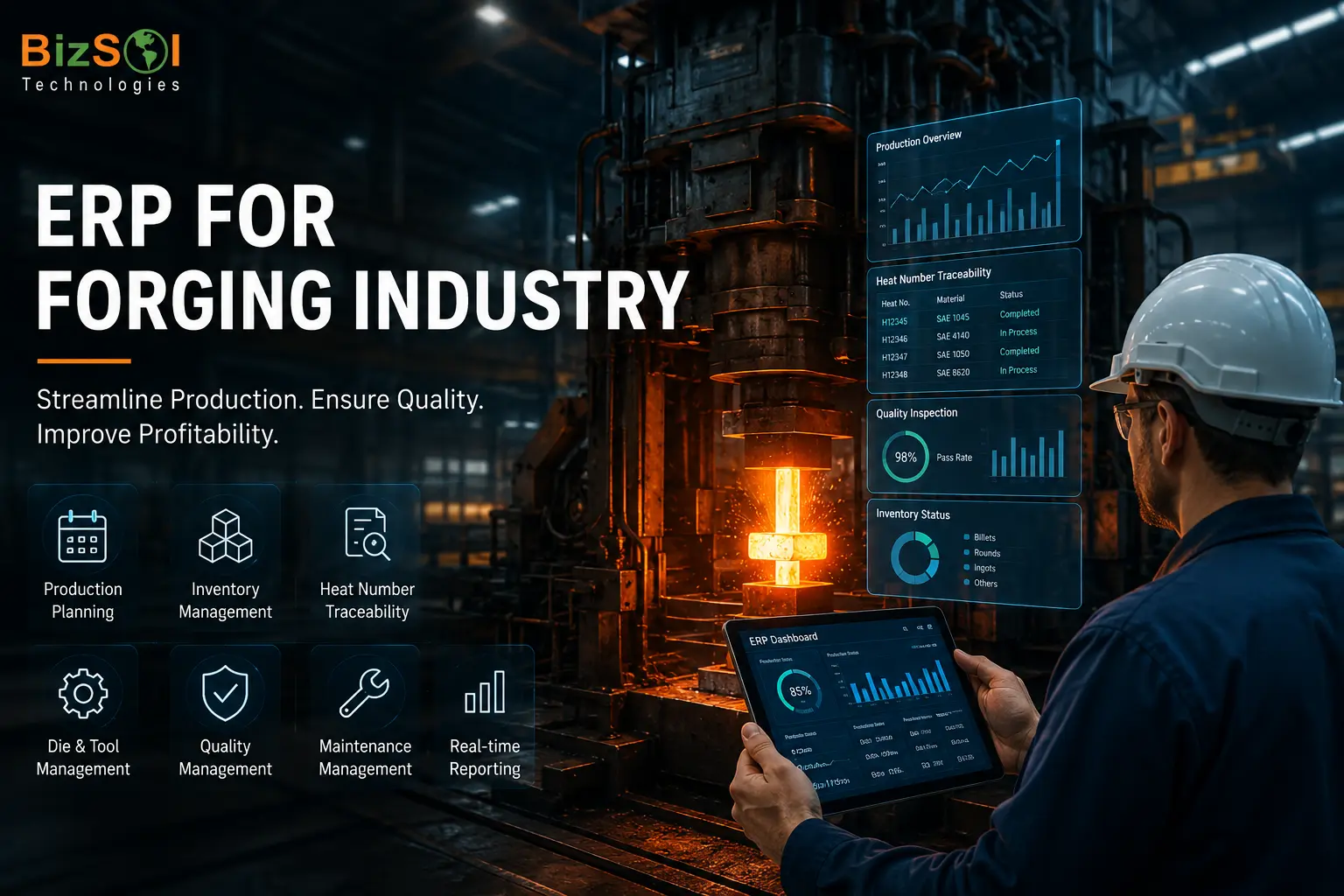

The forging industry operates under immense pressure. Managing high-temperature production cycles, die maintenance, heat number traceability, and complex inventory — all at the same time — is not easy with spreadsheets or outdated software. Many forging manufacturers still rely on disconnected systems that slow down production, increase errors, and reduce profitability.
This is where ERP for forging industry becomes critical. A purpose-built manufacturing ERP solution helps forging businesses streamline production planning, manage inventory accurately, track quality, and reduce operational costs — all from a single platform.
In this guide, you will learn what ERP for forging manufacturers includes, the common challenges it solves, the key features it offers, and how to choose the right ERP software for your forging business.
What is ERP for Forging Industry?
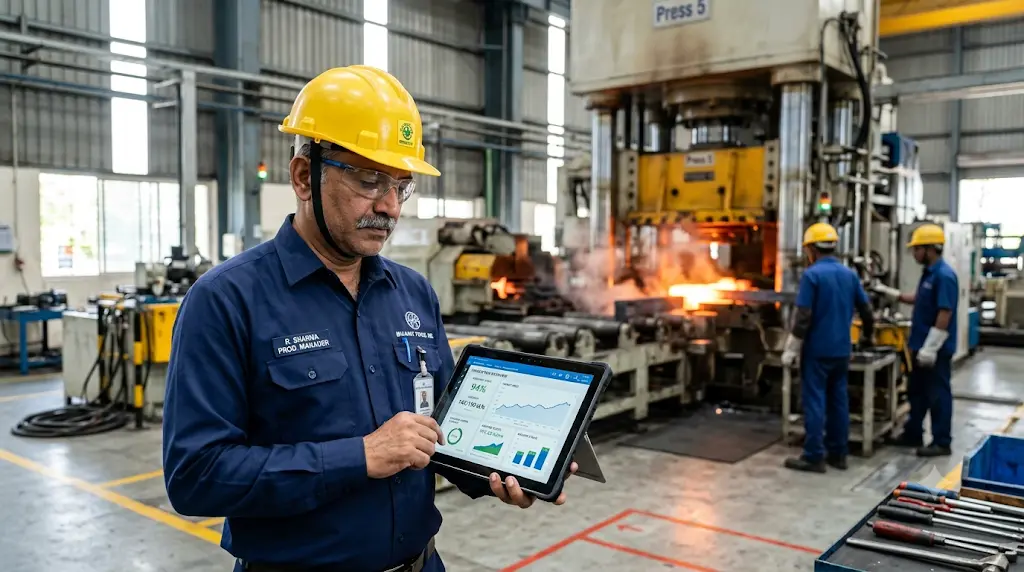
ERP (Enterprise Resource Planning) is an integrated software platform that connects all business processes — production, inventory, procurement, finance, quality, and maintenance — into one system.
However, ERP for forging industry is not the same as a generic ERP. Standard ERP platforms are designed for broad use and often lack the specific tools forging manufacturers need — such as heat number traceability, die management, and batch-level quality control.
Forging ERP software is built with manufacturing-specific workflows in mind. It understands the unique requirements of hot forging, cold forging, and open-die forging operations. It tracks raw material from procurement to finished goods, manages die life cycles, monitors machine performance, and ensures quality compliance at every stage.
For any forging company looking to scale operations and improve profitability, a manufacturing ERP solution is no longer optional — it is a business necessity.
How the Forging Manufacturing Process Works
Every forging shop follows a fairly fixed sequence, even if the die design or press type changes from job to job. Understanding this flow makes it easier to see why ERP for forging industry needs to be different from a standard ERP.
The process starts with raw material procurement. Steel grades and alloy billets are purchased against a production plan, not on guesswork. From there, billets move to cutting, where they are sized to match the part being forged.
Cut billets go into the heating furnace — usually an induction furnace — where they reach forging temperature. They are then shaped on a forging press, which could be a hydraulic press, mechanical press, or power hammer depending on the part geometry.
After forging, parts go through trimming to remove excess flash, followed by heat treatment to achieve the required hardness and grain structure. Machining on CNC or VMC equipment brings parts to final dimensions, and quality inspection checks them against customer specifications before dispatch.
An ERP for forging industry doesn’t just record these stages — it connects them. A work order created at the start of the process carries the heat number and lot number all the way through to dispatch, so every stage stays linked to the same batch.
| Process Stage | What Happens | How ERP Manages It |
|---|---|---|
| Raw Material Procurement | Billets and alloys purchased against demand | MRP-driven purchase requisitions, vendor tracking |
| Billet Cutting | Billets sized for the job | Work order linked to BOM and routing |
| Heating Furnace | Billets heated to forging temperature | Furnace cycle logging, heat number allocation |
| Forging Press | Billet shaped into rough part | Machine utilization and cycle time tracking |
| Trimming | Flash removed | WIP tracking against work order |
| Heat Treatment | Hardness and metallurgical properties set | Batch-linked process parameters |
| Machining | Final dimensions achieved on CNC/VMC | Machine scheduling, tool life tracking |
| Quality Inspection | Parts checked against spec | SPC data capture, PPAP records |
| Dispatch | Finished goods shipped to customer | Traceability record closed against sales order |
This stage-by-stage visibility is what separates a true forging ERP from a generic manufacturing package.
Common Challenges Faced by Forging Manufacturers
Before understanding what ERP for forging companies offers, it helps to look at the challenges that make it necessary.
Challenge | Business Impact |
Production planning delays | Missed delivery deadlines and customer dissatisfaction |
Inventory inaccuracies | Raw material shortages or excess stock tying up capital |
No heat number traceability | Difficulty meeting quality audits and customer compliance requirements |
Poor die & tool management | Unexpected die failures increasing scrap and downtime |
Machine breakdowns | Unplanned downtime reducing overall equipment effectiveness |
Manual quality checks | Higher rejection rates and increased rework costs |
Rising production costs | Reduced margins and difficulty competing on price |
Each of these challenges can be addressed directly with the right ERP for forging industry. The key is choosing a system that understands your shop floor — not just your accounting department.
Types of Forging Processes Supported by ERP
Not every forging operation works the same way, and ERP software for forging companies needs to flex across process types without losing traceability.
Hot Forging Used for larger components like automotive axles and flanges, where billets are heated above recrystallization temperature. ERP requirements center on furnace scheduling and heat number capture at the point of heating. Planning depends on press availability and die readiness. Traceability follows the heat number from furnace to inspection, and quality checks focus on grain flow and dimensional accuracy.
Cold Forging Common for fasteners and small precision parts, done at or near room temperature. ERP here focuses on tool life tracking, since dies wear faster under cold forging loads. Planning is tighter around cycle time, and quality control leans on SPC for dimensional consistency across high-volume runs.
Open Die Forging Used for large, simple shapes like shafts and rings, often in low volumes. ERP requirements are lighter on automation but heavier on job costing, since each job can vary significantly. Traceability is manual-input heavy, and quality checks are typically first-article and final inspection based.
Closed Die Forging Suited to complex, high-precision parts made in dedicated dies — common in automotive and industrial components. ERP must track die life closely, since die cost is high and wear is constant. Planning depends on die availability as much as machine availability, and traceability runs batch-by-batch through the entire routing.
Precision Forging Used where near-net-shape parts reduce machining needs, often in aerospace and defense supply chains. ERP requirements are the strictest here — full batch traceability, PPAP documentation, and tight SPC control are usually mandatory customer requirements, not optional features.
Choosing production planning software that understands these differences matters more than choosing one with the most features on paper.
Key Features of ERP for Forging Industry
A good forging ERP software platform provides purpose-built tools for every area of your manufacturing operation. Here are the most important features to look for.
Production Planning & Scheduling
Production planning software inside a forging ERP helps manufacturers create accurate production schedules based on real-time demand, machine availability, and raw material stock. Instead of manually tracking job orders on spreadsheets, the ERP automatically generates work orders, allocates resources, and flags scheduling conflicts. This reduces production delays and improves on-time delivery rates significantly.
Inventory & Raw Material Management
Raw material management is one of the most important features in ERP for forging industry. The system tracks every raw material — billets, rods, ingots, and alloys — from purchase to consumption on the shop floor. It maintains accurate stock levels, alerts procurement teams when materials fall below minimum thresholds, and helps reduce both shortages and excess inventory.
Heat Number & Batch Traceability
Heat number traceability is a non-negotiable requirement for most forging manufacturers, particularly those supplying to automotive, aerospace, and defense sectors. ERP software for forging companies captures heat numbers at the time of material receipt and tracks them through every production stage — forging, heat treatment, machining, and inspection. This ensures complete batch traceability and makes quality audits far simpler.
Die & Tool Management
Die management is a critical area where forging businesses lose significant money. Forging dies are expensive, and poor tracking leads to unexpected failures and costly repairs. An ERP for forging industry tracks each die’s usage count, maintenance history, and remaining life. The system alerts maintenance teams before a die reaches its limit, reducing unplanned breakdowns and scrap.
Quality Management
Quality management inside a forging ERP solution covers incoming raw material inspection, in-process quality checks, and final product inspection. The system records inspection results against each work order and batch, flags non-conforming materials, and generates quality reports for customer submissions. This reduces rejection rates and builds customer confidence.
Machine Maintenance
Machine maintenance tracking within the ERP helps forging manufacturers shift from reactive to preventive maintenance. The system records each machine’s maintenance schedule, tracks service history, and generates automated alerts when maintenance is due. This is closely connected to predictive maintenance powered by AI — which we will cover in a later section.
Procurement & Vendor Management
Procurement management in a forging ERP connects purchase planning directly with production requirements. When inventory falls below defined levels, the system raises purchase requisitions automatically. It also maintains vendor scorecards, tracks delivery performance, and manages purchase orders — giving procurement teams better control over supply chain reliability.
Work Order Management
Work order management helps forging operations track every job from planning to completion. Each work order is linked to a specific customer order, raw material batch, machine, and operator. This provides complete visibility into production progress and simplifies production costing at the job level.
Real-Time Production Monitoring & Business Intelligence Dashboard
A business intelligence dashboard inside a manufacturing ERP solution gives management real-time visibility into production output, machine utilization, rejection rates, and delivery performance. These dashboards replace manual reporting and help business owners make faster, data-driven decisions. With real-time production monitoring, supervisors can identify bottlenecks on the shop floor before they impact delivery schedules.
Benefits of ERP for Forging Manufacturers
Implementing ERP for the forging industry brings measurable improvements across all areas of the business.
Before ERP | After ERP |
Manual production scheduling leads to delays | Automated scheduling reduces planning time by 60% |
Inventory managed on spreadsheets — frequent mismatches | Real-time inventory visibility eliminates stock errors |
No heat number tracking — audit failures | Complete batch traceability from receipt to dispatch |
Die failures caught only after breakdown | Predictive die maintenance reduces downtime significantly |
Quality checks done manually — high rejection rates | Systematic quality management reduces rejections |
On-time delivery below 75% | On-time delivery improves above 90% with ERP scheduling |
Production costs difficult to calculate accurately | Job-level production costing gives accurate margin data |
Beyond operations, ERP for forging manufacturers also improves customer satisfaction. When orders are delivered on time and quality is consistent, customer retention improves — which directly impacts long-term profitability.
How AI Enhances ERP for Forging Industry
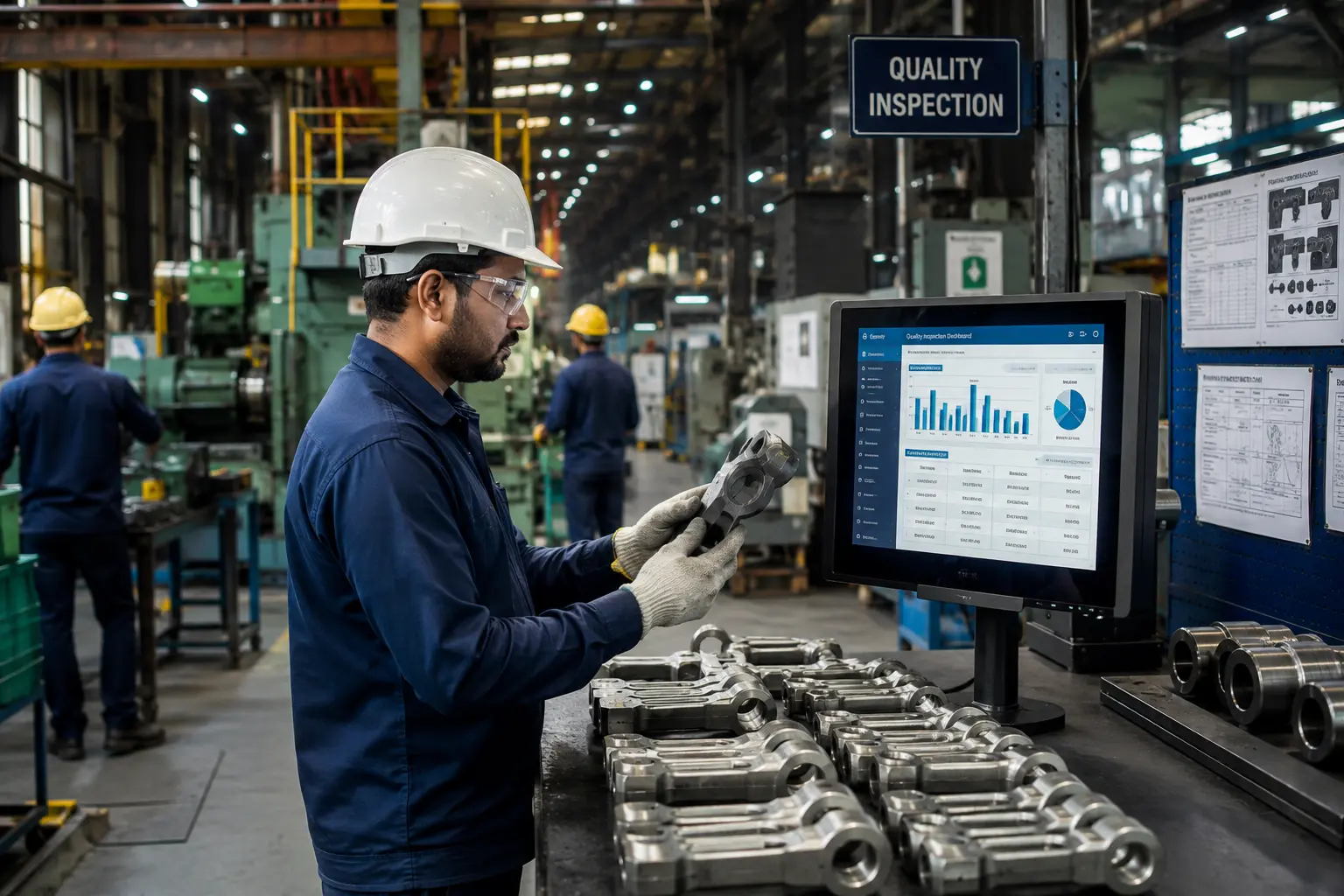
Modern ERP software for forging companies is increasingly incorporating AI-powered capabilities to take operations to the next level. This is part of the broader shift toward smart manufacturing and Industry 4.0.
Predictive Maintenance
AI-powered ERP systems analyze machine sensor data to predict equipment failures before they happen. For forging manufacturers, this means fewer unplanned breakdowns, lower repair costs, and higher machine availability.
AI Demand Forecasting
AI-powered ERP uses historical order data and market trends to forecast future demand more accurately. This helps production planning teams prepare in advance, reducing both overproduction and material shortages.
Production Optimization
AI algorithms inside a manufacturing ERP solution can identify inefficiencies in production sequences and suggest optimized schedules. This reduces cycle times and improves throughput without adding resources.
Quality Inspection with AI
Some forging ERP platforms now integrate with AI-powered vision systems for automated quality inspection. These systems detect surface defects, dimensional errors, and cracks faster and more accurately than manual inspection — reducing scrap and rework costs.
AI enhances the core capabilities of ERP for forging industry. However, the foundation remains solid manufacturing ERP functionality — AI simply makes it smarter and more proactive.
Key Manufacturing KPIs Improved by ERP
An ERP for forging industry earns its cost back through measurable KPI improvement, not just smoother workflows. Here are the KPIs manufacturing leaders track most closely.
| KPI | What It Measures | Why It Matters |
|---|---|---|
| OEE (Overall Equipment Effectiveness) | Combined availability, performance, and quality of a machine | Shows true production capacity being used |
| Machine Utilization | Percentage of available time a machine is actually running | Highlights idle time and scheduling gaps |
| Scrap % | Share of production rejected or discarded | Directly impacts material cost and yield |
| Yield | Usable output versus raw material input | Core profitability metric for forging shops |
| Downtime | Time lost to breakdowns or changeovers | Preventive and predictive maintenance target |
| Production Efficiency | Actual output versus planned output | Reflects planning accuracy and shop floor discipline |
| On-Time Delivery | Orders delivered within promised timelines | Drives customer retention and repeat business |
| Inventory Turnover | How often raw material and WIP inventory cycles through | Indicates working capital efficiency |
| Production Cost | Cost per unit or per work order | Basis for accurate pricing and margin control |
| Cycle Time | Time taken to complete one production cycle | Key lever for increasing throughput |
ERP improves these KPIs by capturing data at the source — the shop floor — instead of relying on end-of-shift paperwork. When machine utilization and scrap data are logged in real time, managers can act on problems the same day, not the same month.
How to Choose the Best ERP for Forging Industry
Choosing the right forging ERP software is one of the most important decisions a manufacturing business will make. Here is a practical checklist to guide your evaluation.
• Industry expertise: Does the vendor understand forging-specific workflows like heat number traceability, die management, and batch tracking?
• Customization: Can the ERP be configured to match your specific production processes without expensive development?
• Scalability: Will the ERP grow with your business as you add production lines, locations, or product categories?
• CNC machine integration: Can the ERP connect with your CNC machines and shop floor equipment for real-time production monitoring?
• Cloud vs On-Premise: Cloud ERP offers faster deployment and lower IT costs, while on-premise gives more control. Choose based on your IT infrastructure and data security preferences.
• Manufacturing automation support: Does the ERP integrate with manufacturing automation tools and IoT devices for smart manufacturing?
• Implementation support: Does the vendor offer dedicated project management, data migration, and training during go-live?
• Ongoing support: What is the vendor’s support model after implementation — tickets, phone, dedicated account manager?
Taking time to evaluate these factors will help you avoid expensive implementation failures and choose an ERP for forging companies that delivers long-term value.
Real Example: How ERP Works Inside a Forging Factory
Here’s how these pieces come together in an actual forging plant supplying automotive components.
A customer places an order for 5,000 forged flanges. The ERP converts this into a production order, checks raw material stock, and raises a purchase requisition for the shortfall in alloy steel billets.
When billets arrive, the storekeeper records the goods receipt in ERP, and a heat number is allocated against that batch. This heat number becomes the thread that ties every later stage back to this specific material lot.
Billets move to cutting, where the work order specifies exact sizes per the routing. The cut billets are heated in the induction furnace and forged on the hydraulic press. Each stage updates the work order status in real time, so the shift supervisor knows exactly where the batch stands.
After forging, the batch goes through heat treatment to achieve the required hardness, followed by inspection against the customer’s drawing and SPC limits. Once cleared, the flanges are dispatched with a lot number tied to the original heat number.
Three months later, the customer reports a crack in one flange during their own assembly line inspection. Without ERP, tracing this back would mean digging through paper registers and guessing which batch it came from.
With ERP, the quality team pulls up the lot number from the dispatch record in seconds. It leads straight back to the heat number, the furnace log, the press cycle data, and the exact inspection report from that run. The team can confirm whether the issue was isolated to one batch or points to a wider process problem — and respond to the customer with facts, not assumptions.
This is what heat number traceability actually delivers on the shop floor: not just a compliance checkbox, but a fast, defensible answer when it matters most.
Why BizSol ERP for the Forging Industry?
BizSol ERP is built specifically for Indian manufacturing businesses, including forging manufacturers. Unlike generic ERP platforms, BizSol understands the operational realities of forging shops — from job-level production costing to multi-stage heat treatment tracking.
• Manufacturing expertise: BizSol’s team has deep experience implementing ERP in forging, casting, machining, and fabrication businesses across India.
• Industry-specific modules: Purpose-built modules for heat number traceability, die management, batch quality control, and shop floor management — all included out of the box.
• AI-powered ERP insights: BizSol leverages AI for predictive maintenance alerts, demand forecasting, and production optimization.
• Real-time dashboards: Business intelligence dashboards give owners and managers instant visibility into production performance, inventory, and financials.
• End-to-end implementation: BizSol manages the complete implementation — from requirement study and data migration to go-live and training.
• Dedicated support: A dedicated support team ensures your manufacturing operations are never disrupted after go-live.
For forging manufacturers looking for an ERP solution that understands their business, BizSol offers a practical, scalable, and cost-effective path forward.
Frequently Asked Questions
1. What is ERP for forging industry?
ERP for forging industry is a specialized manufacturing ERP software platform designed to manage production planning, inventory, heat number traceability, die management, quality control, and procurement for forging manufacturers. Unlike generic ERP, it includes modules built specifically for forging workflows.
2. Why do forging companies need ERP?
Forging companies need ERP to replace manual, disconnected processes with a single integrated system. ERP for forging companies improves production efficiency, reduces material wastage, ensures quality compliance, and provides real-time visibility into operations — directly improving profitability.
3. Can ERP manage heat number traceability?
Yes. A good ERP for forging industry captures heat numbers at material receipt and tracks them through every production stage — forging, heat treatment, finishing, and dispatch. This ensures complete batch traceability and simplifies quality audits for automotive and aerospace customers.
4. How does ERP improve production planning?
ERP improves production planning by automating work order creation, scheduling machines based on availability, and linking production plans to real-time inventory data. Production scheduling inside a forging ERP ensures jobs are completed on time with the right materials and machines.
5. Can ERP integrate with CNC machines?
Yes. Modern manufacturing ERP solutions support CNC machine integration, enabling real-time data collection from the shop floor. This includes production counts, cycle times, and machine status — giving supervisors accurate, live data instead of manual shift reports.
6. Is cloud ERP suitable for forging manufacturers?
Cloud ERP is suitable for most forging manufacturers, especially growing SMEs. It offers lower upfront costs, faster deployment, and remote access to production data. However, businesses with strict data security requirements may prefer on-premise ERP software for forging companies.
7. How long does ERP implementation take for a forging business?
ERP implementation for a forging manufacturer typically takes 3 to 6 months depending on business complexity, number of users, and customization requirements. A phased implementation approach — starting with core production and inventory modules — helps reduce risk and speeds up go-live.
8. What are the key benefits of ERP for forging businesses?
The main benefits of ERP for forging industry include improved production efficiency, accurate inventory management, complete heat number and batch traceability, reduced machine downtime through predictive maintenance, lower scrap rates, better on-time delivery performance, and more accurate production costing.
Conclusion
The forging industry is evolving. Customer demands are rising, quality standards are tightening, and competition is intensifying. Manufacturers who rely on disconnected systems and manual processes will struggle to keep pace.
ERP for forging industry provides the foundation modern forging businesses need — integrated production planning, accurate inventory management, complete batch traceability, quality control, and real-time visibility into operations. With AI-powered capabilities, forging ERP software goes further — predicting maintenance needs, optimizing production schedules, and improving demand forecasting.
BizSol ERP is designed for manufacturers like you. Whether you run a single forging plant or manage multiple production lines, BizSol provides the tools, expertise, and support to transform your operations.
Ready to see how ERP for forging industry can improve your production efficiency and profitability? Contact BizSol today to schedule a free demo and consultation.
Feels like a local joint that actually cares about its regulars. Support is always ready to help and I love how fast the payouts come through to my bank. Keep this bookmark handy for weekend sessions. pejeffersoncasino