
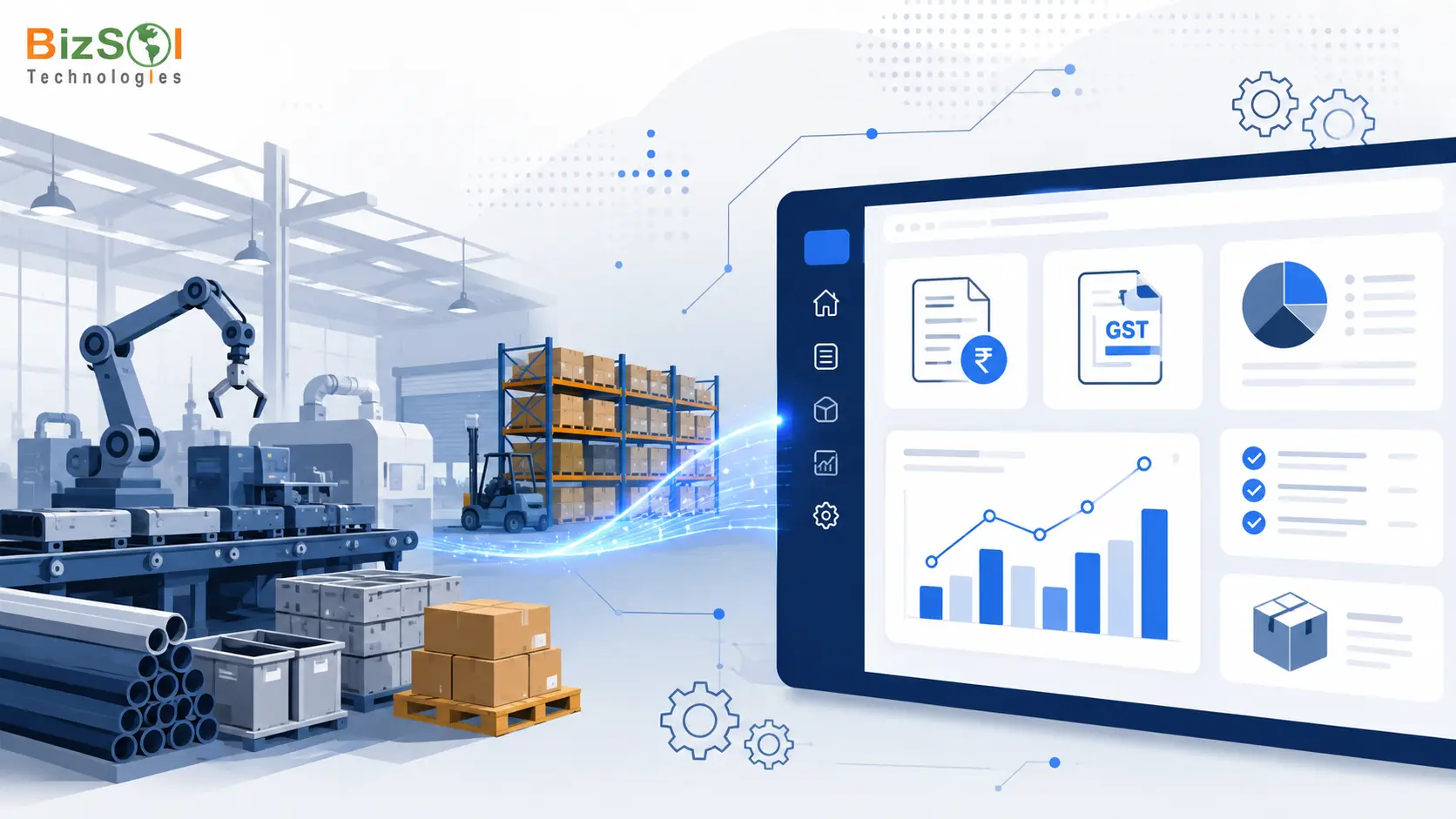

Manual billing works fine when your business is small. But once production scales, things start breaking down fast. Invoices don’t match stock records. GST filing becomes a monthly headache. And your team spends more time fixing errors than closing sales.
This is where the best GST billing software for manufacturing companies in India makes a real difference. It connects billing with inventory, production, and accounting, so your numbers stay accurate at every stage.
In this guide, you’ll learn what manufacturing billing software actually does, how it differs from regular billing tools, which features matter most, and how to choose the right one for your factory.
What Is GST Billing Software for Manufacturing Companies?
GST billing software for manufacturing companies is a system built to handle invoicing, tax compliance, and inventory together, not as separate tasks.
Regular billing software only creates invoices. Manufacturing billing software does more. It tracks raw material purchase, links stock movement to production, and generates GST-compliant invoices automatically.
This matters because manufacturers deal with multiple stages before a product is ready to sell. A tool built only for retail billing simply can’t handle that complexity.
How Manufacturing Billing Differs from Normal Billing
A shop selling finished goods only needs to record a sale. A factory needs much more.
Manufacturing billing software tracks batch numbers, lot tracking, and raw material consumption. It also connects purchase orders to production output, so stock levels stay accurate.
This is why generic billing software often falls short for manufacturers. It wasn’t built to handle production management or multi-stage inventory movement.
Why Manufacturers Need GST Billing Software
Growing manufacturers often start with spreadsheets or basic billing tools. This works until order volume increases.
GST compliance gets harder as you scale. Manual entry increases the risk of mismatched tax filings, which can lead to penalties during audits.
Inventory and billing must stay connected. Without this link, stock records drift away from actual factory floor numbers, leading to overselling or production delays.
This is where dedicated manufacturing ERP software becomes useful. It brings billing, inventory, and production planning into one system, so nothing gets missed.
In most cases, manufacturers switch to GST billing software once they start managing multiple product lines or supplying to several buyers at once.
Problems Manufacturers Face Without Billing Software
Many manufacturers run into the same issues before adopting proper billing software:
• Inventory mismatches: stock on paper doesn’t match stock on the shop floor
• Manual GST errors: wrong tax slabs or missed e-invoice generation
• Production delays: no visibility into raw material availability
• Reporting gaps: no clear data during audits or investor reviews
• Disconnected departments: purchase, production, and accounts working in silos
Each of these problems compounds as the business grows. What feels manageable at a small scale becomes a serious bottleneck at higher production volumes.
For example, a factory managing multiple production lines may find that one line runs out of raw material simply because purchase and production teams were using separate spreadsheets. This kind of gap is common in businesses that haven’t yet connected departments through a single billing and inventory system.
Similarly, manufacturers handling custom production often face pricing errors when invoices are prepared manually. A small mistake in raw material costing can affect margins across an entire order, especially for businesses with complex BOM structures.
Manufacturing Workflow Explained
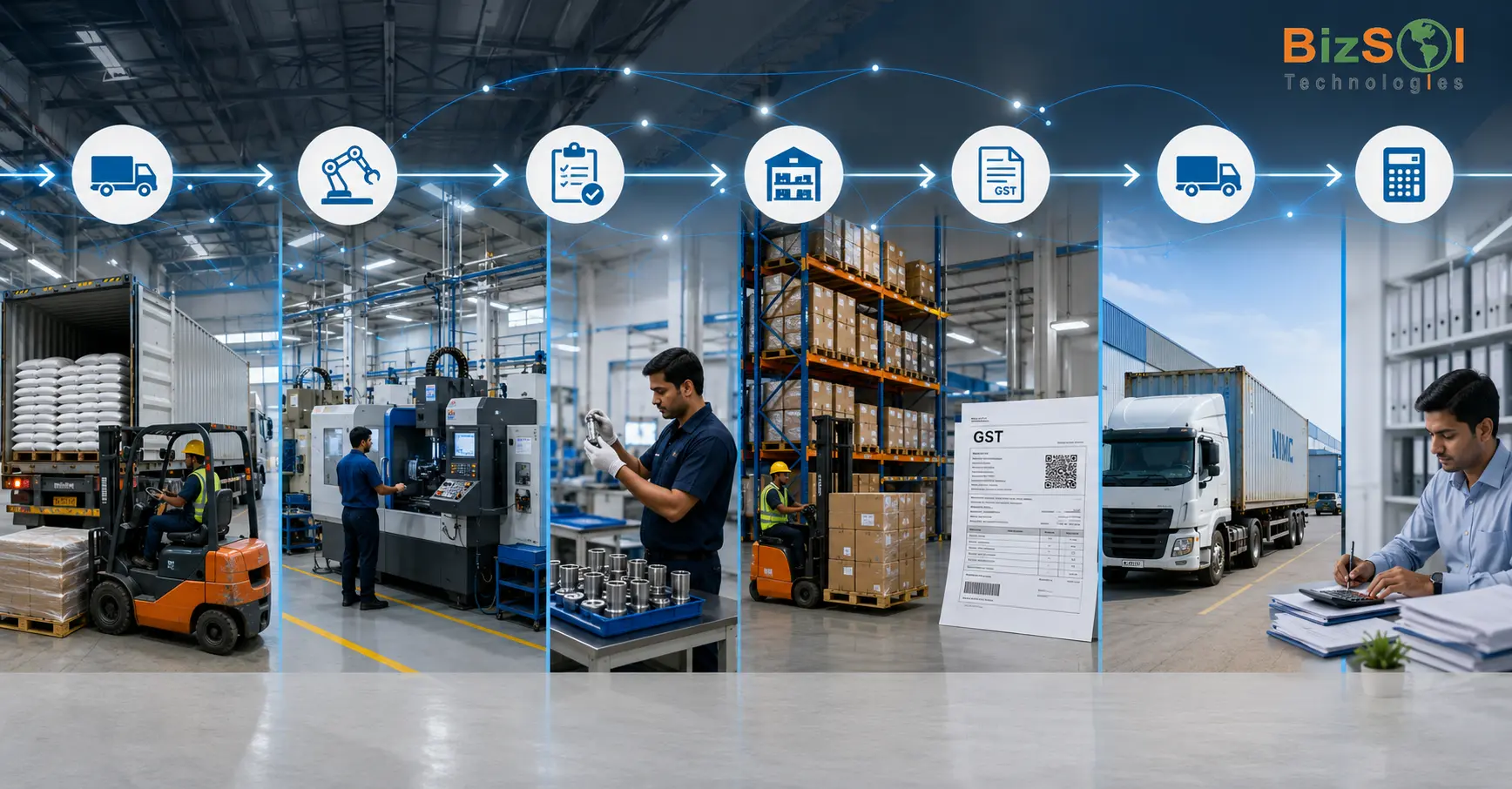
To understand why manufacturing billing software works differently, it helps to see the full workflow it needs to support:
Purchase → Raw Material → Production → Inventory → Billing → Dispatch → Accounting
Here’s what happens at each stage:
- Purchase: raw materials are ordered from suppliers
- Raw Material: stock is received and recorded
- Production: materials are converted into finished goods
- Inventory: finished stock is updated in real time
- Billing: GST-compliant invoices are generated for buyers
- Dispatch: goods are shipped with proper documentation
- Accounting: payments, GST returns, and reports are reconciled
This is the core reason manufacturing billing software needs deeper functionality than a typical invoicing tool. Every stage feeds into the next, and errors early in the chain show up later as billing mistakes.
An ERP-integrated billing software connects each of these steps automatically, reducing manual handoffs between teams.
Key Features to Look For
Not every billing software is built for factories. Here are the features that matter most for manufacturing businesses.
GST Invoice and GST Reports
Automatic GST-compliant invoice generation reduces manual tax calculation errors. This helps manufacturers stay audit-ready without extra accounting work every month.
Inventory Integration and Real-Time Inventory
When billing is connected to inventory, stock updates automatically after every sale or production run. This helps manufacturers avoid overselling and plan purchases more accurately.
Multi-Branch Billing
Factories with more than one unit or warehouse need centralized billing. This gives management a single view of sales and stock across all locations.
Barcode Billing
Barcode-based billing speeds up dispatch and reduces manual entry errors. This is especially useful for factories handling high SKU volumes.
Purchase Billing and Sales Billing
Tracking both purchase and sales invoices in one system helps manufacturers reconcile costs against revenue more easily, which supports better margin planning.
Cloud Billing vs Desktop Billing
Cloud billing software works well for growing manufacturers who need access from multiple locations. Desktop billing suits factories with limited internet reliability but a single fixed unit.
Financial Reports and Expense Tracking
Detailed reports on expenses and revenue give owners a clearer picture of profitability. This also makes it easier to prepare for GST filings and audits.
Data Security
Manufacturing data includes supplier contracts, pricing, and production details. Strong data security protects this information from unauthorized access or loss.
ERP Integrated Billing Software
When billing connects directly with your ERP, data flows automatically between purchase, production, inventory, and accounts, removing the need for manual data entry between systems.
Production Scheduling Support
Some manufacturing billing tools also link with production scheduling, so billing teams know when a batch is ready for dispatch. This reduces delays between production completion and invoice generation, which matters for businesses managing multiple production lines at once.
Procurement and Supplier Tracking
Tracking procurement cycles alongside billing helps manufacturers plan raw material orders more accurately. This is particularly useful for factories that depend on multiple suppliers with different lead times.
Benefits of Using Manufacturing Billing Software
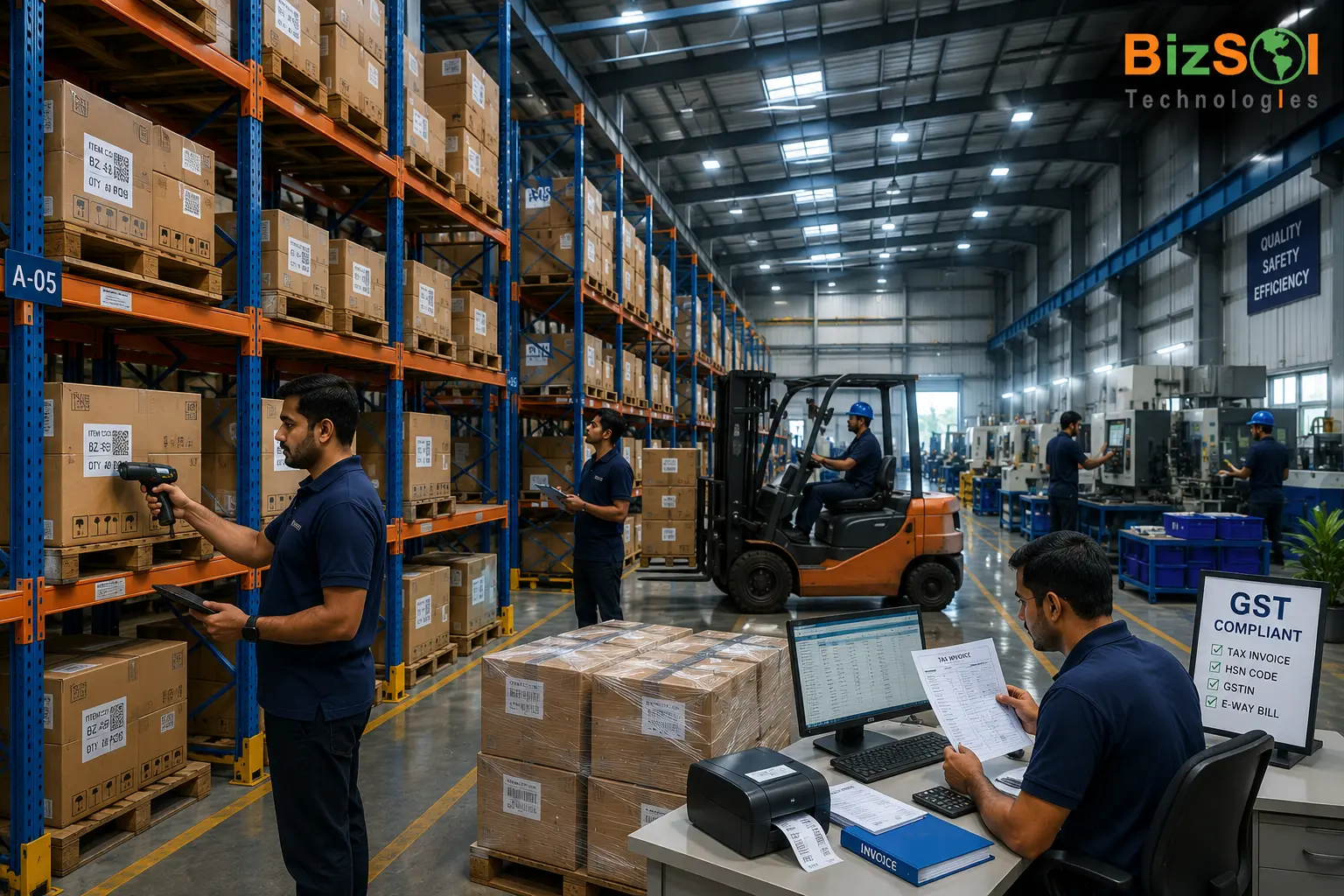
Manufacturers who switch to dedicated billing software typically see fewer stock errors and faster invoice generation.
Additionally, GST filing becomes simpler because tax calculations happen automatically at the time of billing.
As a result, audit preparation takes less time, since reports are already structured and accurate.
This also helps businesses that supply to larger buyers, who often require clean documentation and GST-compliant invoices for their own compliance.
On the other hand, manufacturers who continue using disconnected systems often find that their teams spend hours reconciling numbers manually at month-end. This time adds up, especially for factories managing multiple warehouses or production lines.
Better supply chain visibility is another advantage worth mentioning. When billing data connects with procurement and inventory, business owners get a clearer picture of demand forecasting, which helps with planning future raw material purchases more confidently.
Industry Use Cases
Different manufacturing sectors use billing software slightly differently, based on their production style.
Industry | How Billing Software Helps |
Steel | Tracks raw material weight-based billing and batch-wise stock |
Pipe Manufacturing | Manages size and grade variations across large SKU counts |
Plastic | Links raw material (resin) consumption to finished units |
Chemical | Supports batch and lot tracking for compliance purposes |
Engineering | Handles custom orders with variable BOM structures |
Foundry | Tracks metal input against casting output accurately |
Packaging | Manages high SKU volume with barcode-based billing |
Electrical | Supports multi-branch billing across distribution units |
Most of these industries deal with complex BOM structures or custom production, which is exactly where generic billing tools fall short.
Businesses with complex BOM structures, in particular, benefit from software that tracks each input material against the final output. This level of detail is difficult to maintain manually, especially once order volume increases across multiple product lines.
Manual Billing vs GST Billing Software
Factor | Manual Billing | GST Billing Software |
GST Compliance | High error risk | Automatic and accurate |
Inventory Accuracy | Often mismatched | Real-time updates |
Time Required | High | Significantly reduced |
Audit Readiness | Difficult | Straightforward |
GST Billing Software vs ERP
Factor | GST Billing Software | Full ERP |
Scope | Billing and basic inventory | Full business operations |
Best For | Small to mid-size manufacturers | Larger, multi-department factories |
Implementation | Faster | Longer, more involved |
Desktop Billing vs Cloud Billing
Factor | Desktop Billing | Cloud Billing |
Access | Single location | Multiple locations |
Internet Dependency | Low | Required |
Best For | Single-unit factories | Growing, multi-branch manufacturers |
Generic Billing vs Manufacturing Billing Software
Generic billing software is built for retail or service businesses. Manufacturing billing software, on the other hand, is designed around production stages, raw material tracking, and multi-level inventory, making it a better fit for factories with complex operations.
Buying Guide: 10 Things to Check Before Buying
Choosing the right billing software takes more than comparing prices. Here’s a practical checklist:
- Does it support GST-compliant invoicing, including e-invoice and e-way bill generation? This is non-negotiable for staying audit-ready.
- Can it integrate with your existing ERP or production system? Without this, teams end up re-entering the same data twice.
- Does it track raw materials and finished goods separately? This is essential for accurate costing and stock planning.
- Is real-time inventory tracking included? Delayed stock updates lead to overselling or production stoppages.
- Does it support multi-branch billing if you operate more than one unit? Centralized visibility saves significant reconciliation time.
- Is barcode billing available for faster dispatch? This matters more for high SKU-count businesses like packaging or electrical manufacturers.
- What reporting options does it offer for audits and GST returns? Good reporting reduces last-minute scrambling before filing deadlines.
- Is it cloud-based or desktop-based, and which suits your operations better? This depends on how many locations you manage.
- How strong is the data security framework? Supplier pricing and production data need proper protection.
- Does the vendor offer implementation support and training? Smooth onboarding often matters more than the feature list itself.
This checklist helps manufacturers avoid picking software based on price alone, which often leads to switching systems again within a year.
Pricing Guide
GST billing software pricing varies based on features, number of users, and whether it’s cloud-based or desktop-based.
In most cases, cloud billing software follows a subscription model, while desktop software may involve a one-time license cost.
Rather than focusing only on upfront cost, it helps to consider implementation support, training, and long-term scalability, since switching software later can be more disruptive than the initial price difference.
Larger enterprises usually require more advanced modules, which can affect pricing. Small manufacturers typically prefer a more affordable, streamlined version with core billing and inventory features, upgrading to advanced modules only as their operations grow.
How to Implement Manufacturing Billing Software
Implementation usually works best in stages. Start with billing and inventory, then gradually connect production and accounting modules.
Many manufacturers prefer a phased rollout rather than switching everything at once. This reduces disruption to daily operations and gives teams time to adjust.
Working with a vendor experienced in manufacturing-specific implementation also helps avoid common configuration mistakes.
Before rollout, it’s worth mapping your current purchase, production, and dispatch process on paper. This makes it easier to configure the software correctly the first time, rather than making changes after staff have already started using it.
Larger enterprises usually require more configuration time, since they often manage multiple warehouses and production lines. Small manufacturers typically prefer a simpler setup that can go live within a few weeks.
Mistakes to Avoid
• Choosing software based only on price, without checking manufacturing-specific features
• Skipping ERP integration planning, which leads to duplicate data entry later
• Ignoring staff training, which slows down adoption
• Not checking GST compliance updates, since tax rules change periodically
• Overlooking data backup and security during vendor selection
• Rushing implementation without mapping the current workflow first
• Choosing a system that doesn’t scale with future warehouse or production line additions
Avoiding these mistakes early saves significant rework later. In many cases, the cost of switching software after a poor initial choice is higher than the cost of choosing carefully the first time.
The Future of AI in Manufacturing Billing
AI-powered dashboards are becoming more common in manufacturing billing software. These tools help identify patterns in stock movement and flag unusual billing entries automatically.
This gives business owners better visibility into production and sales trends, supporting faster decision-making without manually reviewing every report.
Business intelligence features like this are especially useful for manufacturers managing multiple product lines or branches.
Over time, these tools are expected to play a bigger role in demand forecasting as well, helping factories plan procurement based on historical sales and production data rather than manual estimates. This is still an emerging area, but early adoption gives growing manufacturers a practical advantage in planning ahead.
Why BizSol e@sy Billing Is a Practical Choice
BizSol e@sy Billing is designed to simplify GST billing for manufacturers by connecting invoicing, inventory, and business operations in one platform. Instead of relying on separate tools for billing, stock management, and accounting, manufacturers can manage everything from a single system.
Key capabilities include GST-compliant invoicing, real-time inventory tracking, purchase and sales billing, barcode billing, multi-user and multi-branch management, detailed financial reporting, and seamless ERP integration. These features help reduce manual work, improve billing accuracy, and keep inventory synchronized across departments.
The software is suitable for manufacturers in industries such as steel, engineering, foundry, plastic, packaging, pipe manufacturing, electrical products, and other production-based businesses that require accurate inventory and GST compliance.
As businesses grow, BizSol e@sy Billing can also integrate with BizSol ERP, enabling manufacturers to connect production planning, procurement, inventory, finance, and billing without disrupting existing operations.
Frequently Asked Questions
What is GST billing software for manufacturing companies?
It’s a billing system designed for factories that combines GST-compliant invoicing with inventory and production tracking, unlike generic billing tools built for retail.
Why do manufacturers need GST billing software?
Manufacturers deal with multi-stage inventory and complex GST filing. Dedicated software reduces errors and keeps billing accurate as production scales.
Which is the best GST billing software for manufacturers?
The best GST billing software for manufacturing companies in India typically includes ERP integration, real-time inventory, and multi-branch support, features found in solutions like BizSol e@sy Billing.
Can GST billing software manage inventory?
Yes. Most manufacturing billing tools include real-time inventory tracking that updates automatically with each sale or production run.
Can GST billing software integrate with ERP?
Yes, ERP-integrated billing software connects purchase, production, and accounting data automatically, reducing manual entry across departments.
How much does GST billing software cost?
Pricing depends on features, number of users, and deployment type. Cloud solutions are usually subscription-based, while desktop software may involve a one-time cost.
What features should manufacturing businesses look for?
Look for GST compliance, real-time inventory, ERP integration, multi-branch support, and strong reporting, since these directly address common manufacturing billing challenges.
Is cloud GST billing software better than desktop software?
Cloud billing works better for manufacturers with multiple locations, while desktop billing suits single-unit factories with limited internet dependency.
How does GST billing software improve production and billing accuracy?
By connecting inventory directly to billing, it removes manual data entry gaps that often cause mismatched stock and incorrect invoices.
Is GST billing software suitable for MSME manufacturers?
Yes, many MSME manufacturers use GST billing software to manage compliance and inventory without needing a full-scale ERP system right away.
Conclusion
Choosing the best GST billing software for manufacturing companies in India comes down to one thing: does it understand how factories actually work?
Generic billing tools handle invoices. Manufacturing billing software handles your entire workflow, from raw material to dispatch to GST filing.
The right software should feel like it was built for your factory floor, not adapted from a retail checkout system. That difference shows up in fewer errors, faster billing cycles, and smoother GST filing every month.
If you’re looking for GST billing software that supports manufacturing workflows, inventory management, and GST compliance from a single platform, BizSol e@sy Billing is a practical solution. Schedule a free demo to see how it can streamline billing, inventory, and day-to-day manufacturing operations while supporting your business as it grows.

Finally found a site that pays out quickly without any hassle. Great experience and great support. Check out n9995game if you want a reliable spot.
I carry my favorite slot adventures in my pocket now and I could not be happier about it. The app loads fast and keeps all the bright lights and cool sounds running like magic. It is like having a little lounge right at my fingertips. Download jl77slotapp whenever you want a quick and joyful break. jl77slotapp