
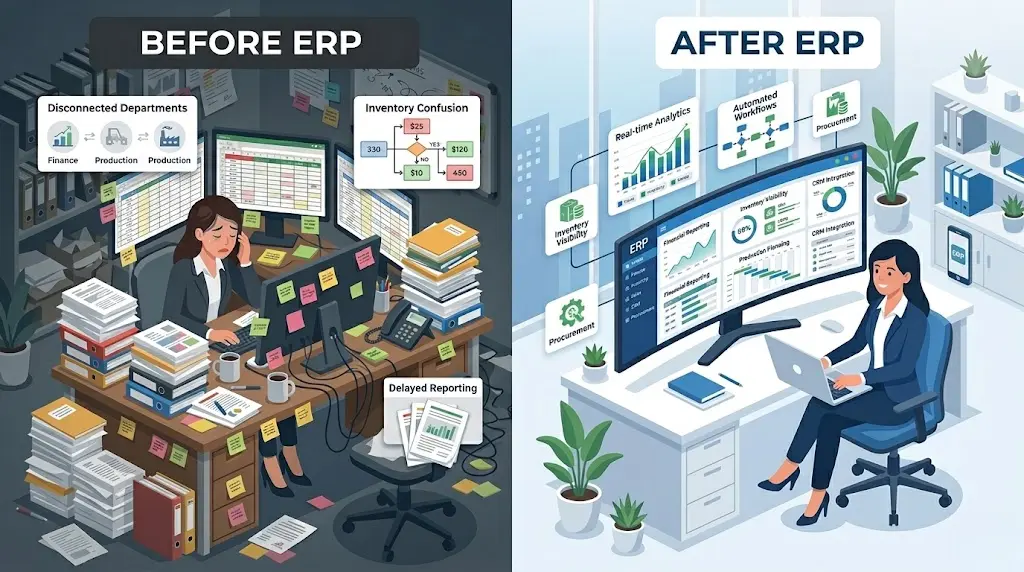
Businesses in 2026 face constant pressure to improve efficiency, cut operational costs, and make faster decisions. Many organizations still struggle with disconnected systems, manual processes, delayed reporting, inventory mismatches, and communication gaps between departments — challenges that directly impact productivity, customer satisfaction, and long-term growth.
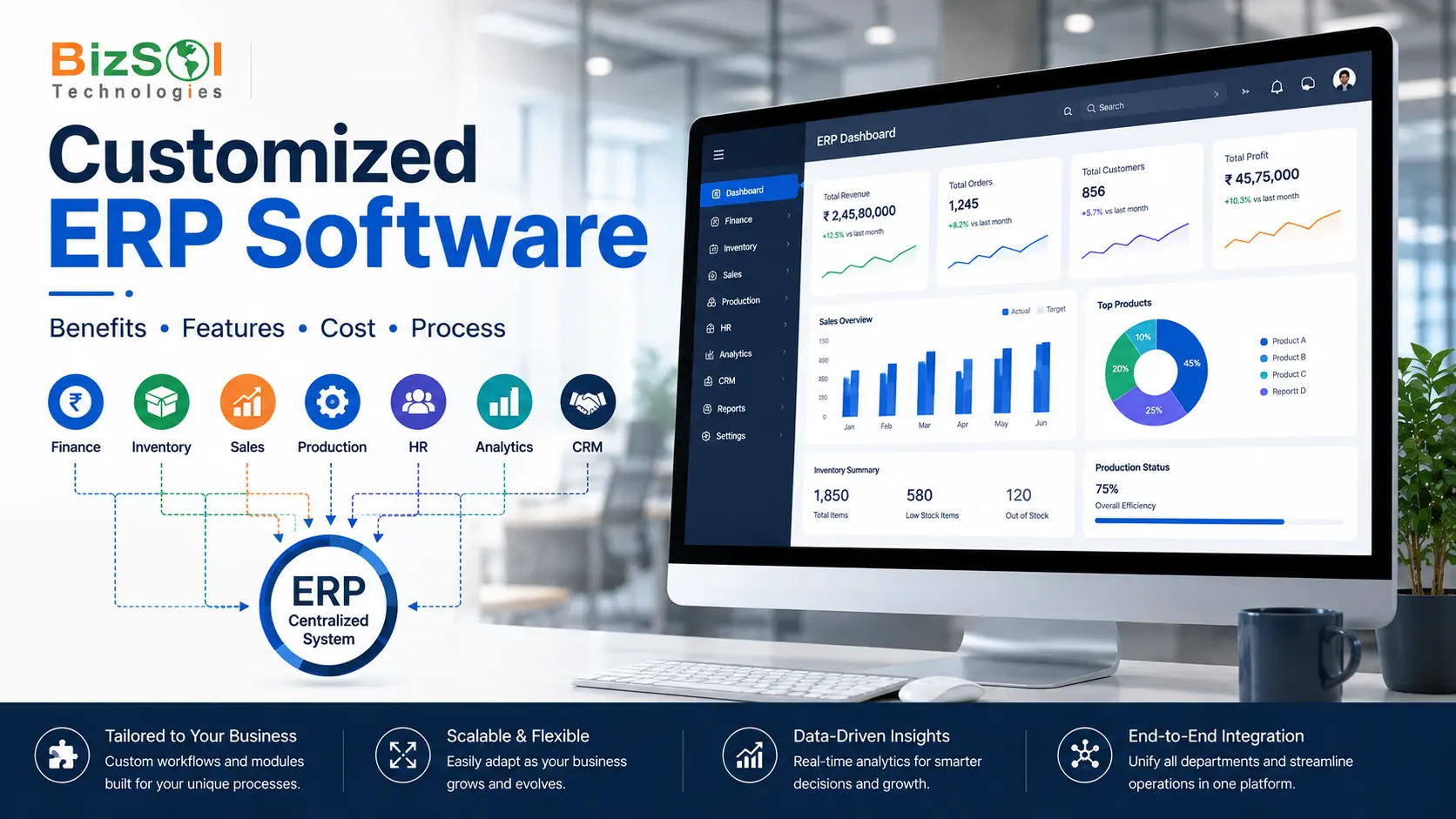
Understanding the benefits of ERP software has never been more critical for modern businesses. Enterprise resource planning systems help organizations automate workflows, centralize data, improve visibility across operations, and build scalable processes that support sustained growth. From manufacturers and distributors to retail stores and service-based companies, businesses across sectors are adopting ERP solutions to stay competitive in a rapidly evolving digital landscape.
As companies continue prioritizing automation, real-time analytics, and operational transparency, ERP adoption is no longer exclusive to large enterprises. Small and mid-sized businesses are also investing in ERP technology to streamline operations, improve collaboration, and achieve sustainable growth through digital transformation.
Top Benefits of ERP Software for Modern Businesses
ERP systems have become essential for organizations looking to improve operational efficiency and business agility. The advantages of ERP software extend far beyond simple process automation — modern ERP platforms connect every department, provide real-time visibility, and empower teams to make data-driven decisions faster and with greater confidence.
1. Improved Operational Efficiency
One of the most significant benefits of ERP software is improved operational efficiency across all departments. Many businesses struggle with repetitive manual tasks, disconnected workflows, and delayed approvals that slow daily operations. ERP systems automate critical processes such as invoicing, purchase orders, inventory updates, and production scheduling — improving workflow accuracy and reducing processing time.
With better process automation, businesses can reduce operational delays, minimize human errors, and improve coordination between teams. These ERP software benefits are especially valuable for growing companies that need faster communication, better resource planning, and streamlined operations across multiple departments or locations.
2. Centralized Business Data and Single Source of Truth
ERP software centralizes business data into one unified platform, giving every department access to accurate, real-time information. Instead of maintaining separate records for finance, inventory, sales, and operations, ERP systems eliminate data silos and create a single source of truth that improves collaboration and decision-making.
This centralized approach reduces data duplication and helps teams act faster. Sales teams can instantly verify stock availability, finance departments can monitor payments in real time, and management can access consolidated reports without relying on multiple disconnected systems.
3. Real-Time Reporting and Business Intelligence
Modern ERP systems deliver live dashboards, KPI tracking, and real-time reporting that enable businesses to make faster, more informed decisions. Instead of waiting for manually compiled reports, organizations can monitor sales performance, production status, procurement activities, and financial health at any moment.
Real-time business intelligence also helps identify operational bottlenecks, improve demand forecasting, and optimize resources more effectively. These ERP system benefits are among the most valuable for strategic planning, business growth, and long-term operational improvement.
4. Better Inventory and Supply Chain Management
Inventory management becomes significantly more efficient with ERP software. Businesses gain complete visibility into stock movement, warehouse operations, and procurement activities. ERP systems help companies avoid overstocking, reduce stock shortages, and improve supply chain coordination across multiple locations.
Manufacturers can plan raw material purchases more accurately, while distributors can improve logistics and delivery tracking. The business benefits of ERP in inventory and supply chain management are particularly important for companies managing large-scale operations or complex multi-warehouse environments.
5. Increased Employee Productivity
ERP software significantly reduces repetitive administrative work, allowing employees to focus on higher-value tasks that drive business outcomes. Automated workflows improve task tracking, interdepartmental communication, and accountability across the organization.
Employees spend less time searching for data or manually updating records. This creates a more productive, collaborative, and efficient work environment — one where teams can respond to business needs faster and with greater accuracy.
6. Improved Customer Experience
Customer expectations continue to rise in 2026. ERP systems help businesses improve response times, order accuracy, and overall service quality through better process integration. Sales teams can instantly access customer histories, order statuses, and live inventory availability.
Faster order processing and accurate delivery timelines directly improve customer satisfaction and strengthen long-term relationships — a key business benefit of ERP for customer-facing teams.
7. Financial Management and Cost Control
ERP software gives businesses greater control over budgets, expenses, and cash flow. Automated accounting processes reduce manual errors, improve financial accuracy, and accelerate period-end close activities. Finance teams can generate reports faster, monitor profitability by product or region, and maintain tighter control over operational costs.
Businesses also benefit from simplified compliance reporting, audit trail management, and improved regulatory readiness — all of which reduce financial risk and administrative overhead.
8. Business Scalability and Long-Term Growth
As businesses expand, managing operations manually becomes increasingly difficult and error-prone. ERP systems support scalability by standardizing processes across departments, branches, and geographic locations. Whether a company is opening new warehouses, expanding into new markets, or increasing production capacity, ERP software provides the operational foundation needed for sustainable growth.
The importance of ERP software for scalability becomes especially clear when businesses need to onboard new teams quickly or integrate new product lines without disrupting existing operations.
9. Better Compliance and Data Security
Modern ERP systems include role-based access controls, detailed audit trails, and enterprise-grade security protocols that help businesses protect sensitive data and maintain regulatory compliance. This is especially critical for industries handling financial records, manufacturing regulations, healthcare data, or customer personally identifiable information (PII).
Built-in compliance tools reduce the risk of regulatory penalties and provide businesses with greater confidence during audits and inspections.
ERP Software Benefits for Different Industries
The ERP software advantages for businesses vary by sector. Here is how different industries leverage ERP systems to solve their unique operational challenges:
Manufacturing Industry
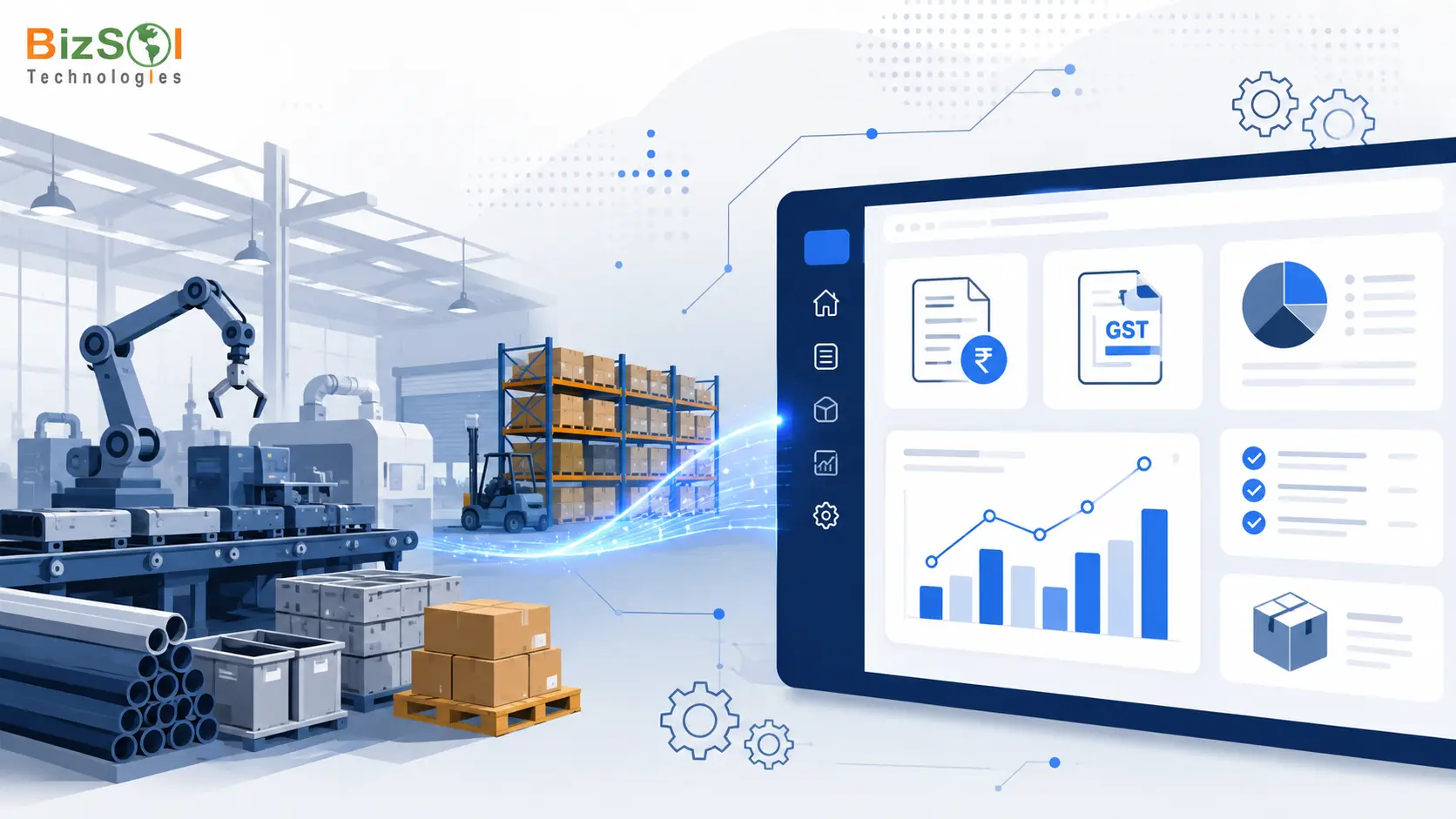
ERP software helps manufacturers improve production planning, manage raw material availability, monitor machine utilization, and gain real-time shop floor visibility. Many organizations adopt manufacturing ERP software to streamline operations and improve production efficiency.Key ERP implementation benefits for manufacturing include:
● Accurate production scheduling and capacity planning
● Real-time inventory tracking across raw materials, WIP, and finished goods
● Quality control and regulatory compliance management
● Reduced production downtime through predictive maintenance insights
Retail Businesses
Retail businesses use ERP systems to manage multi-store inventory, integrate point-of-sale (POS) systems, track customer buying behavior, and optimize stock replenishment across all sales channels. ERP system benefits for retail include:
● Centralized inventory across all store locations and online channels
● Customer purchase history and loyalty program management
● Automated replenishment to reduce stockouts and overstock
● Unified financial reporting across all retail units
Distribution & Supply Chain
Distribution companies leverage ERP solutions to streamline warehouse coordination, improve logistics visibility, track shipments in real time, and ensure faster, more accurate order fulfillment. Cloud ERP benefits for distribution include:
● End-to-end supply chain visibility from procurement to delivery
● Automated warehouse management and pick/pack/ship workflows
● Real-time freight tracking and carrier performance monitoring
● Improved vendor management and supplier collaboration
Service-Based Businesses
Service organizations use ERP to improve resource allocation, project management, billing automation, and customer communication while maintaining operational transparency across teams. ERP advantages for service businesses include:
● Project cost tracking and profitability analysis
● Resource scheduling and utilization management
● Automated invoicing and billing workflow
● Customer portal integration for improved service delivery
ERP Software vs. Traditional Business Management Systems
The following comparison highlights why businesses are replacing legacy systems with modern ERP platforms:
Feature | Traditional System | ERP Software |
Data Management | Separate, siloed systems | Centralized unified platform |
Reporting | Manual, delayed reports | Real-time analytics & dashboards |
Workflow Automation | Limited or none | Advanced end-to-end automation |
Department Collaboration | Fragmented & disconnected | Fully integrated across teams |
Scalability | Difficult to scale | Easy expansion & growth support |
Decision Making | Slow, data-poor | Fast, data-driven insights |
As this comparison shows, the advantages of ERP software over traditional systems are significant — particularly in visibility, speed, and scalability.
How ERP Software Drives Business Growth

ERP software supports long-term business growth by improving operational visibility, forecasting accuracy, and process optimization. Businesses can identify inefficiencies faster, reduce unnecessary costs, and make strategic decisions based on real-time insights rather than outdated reports.
The business benefits of ERP system adoption also include stronger competitive positioning, better customer experiences, and improved digital transformation readiness. Companies using ERP solutions are consistently better equipped to scale operations efficiently while maintaining quality and operational consistency.
Expert insight: According to industry research, businesses that implement ERP solutions report measurable improvements in reporting speed, inventory accuracy, and cross-departmental collaboration within the first 12 months of deployment. These gains compound over time as teams become more proficient with the platform.
Key Considerations Before Implementing ERP
Before investing in ERP software, businesses should carefully evaluate the following implementation factors to ensure a successful deployment:
● Budget and total cost of ownership (software, implementation, training, support)
● Employee change management and user training requirements
● Data migration complexity and data cleansing needs
● Integration requirements with existing tools and legacy systems
● Future scalability and vendor roadmap alignment
Choosing the right ERP vendor is equally important. Businesses should prioritize industry-specific functionality, proven implementation methodology, customization flexibility, and long-term support capabilities. Proper pre-implementation planning dramatically improves ERP adoption rates and accelerates time-to-value.
Balanced consideration: While ERP implementation benefits are substantial, businesses should approach deployment in phases where possible. A phased rollout reduces disruption, allows for iterative training, and gives teams time to adapt to new workflows before the next module goes live.
The Future of ERP Software in 2026 and Beyond
The future of enterprise resource planning is increasingly shaped by artificial intelligence, machine learning, and cloud technology. Businesses are adopting AI-powered ERP systems for predictive analytics, demand forecasting, and intelligent process automation that goes beyond traditional rule-based workflows.
Cloud ERP benefits continue to expand as vendors improve platform reliability, security, and integration capabilities. Cloud-based ERP offers businesses flexibility, remote accessibility, automatic updates, and significantly lower infrastructure costs compared to on-premise deployments. Mobile ERP platforms are also enabling teams to manage operations, approve workflows, and access business intelligence from anywhere.
As digital transformation accelerates across all industries, the ERP software benefits of today will continue evolving — becoming smarter, more predictive, and more deeply integrated with the broader business technology ecosystem.
FAQS About Benefits of ERP Software
1. What are the main benefits of ERP software?
The main benefits of ERP software include improved operational efficiency, workflow automation, centralized business data, real-time reporting, better inventory management, and stronger financial control. ERP systems also improve interdepartmental collaboration and support long-term business scalability.
2. Why do businesses invest in ERP systems?
Businesses invest in ERP systems to eliminate data silos, reduce manual work, improve visibility across all departments, and support long-term growth. The ERP software advantages become especially clear as organizations scale — standardized processes make it easier to manage complexity without adding headcount.
3. How does ERP software improve productivity?
ERP software improves productivity by automating repetitive tasks, streamlining approvals, and giving employees real-time access to the information they need. This reduces delays, minimizes errors, and frees teams to focus on strategic work rather than manual administration.
4. What industries benefit most from ERP software?
Manufacturing, retail, distribution, healthcare, construction, and service industries benefit most from ERP systems due to their complex operational requirements. However, any business managing inventory, financials, production, or multiple departments can realize significant ERP system benefits.
5. Is ERP suitable for small businesses?
Yes. Modern cloud ERP solutions are specifically designed to be accessible and affordable for small and medium-sized businesses. Cloud ERP benefits for SMBs include lower upfront costs, faster implementation, and scalable pricing that grows with the business.
6. What is the most important advantage of ERP systems?
The most important advantage is centralized operational visibility — giving leadership a complete, real-time picture of business performance across all departments. This single source of truth improves decision-making speed, reduces errors, and enables proactive rather than reactive management.
7. How does ERP software reduce operational costs?
ERP reduces operational costs by automating workflows, eliminating manual data entry errors, optimizing inventory levels, and improving resource utilization. Businesses also reduce costs associated with compliance failures, delayed reporting, and poor supply chain coordination.
8. What is the difference between cloud ERP and on-premise ERP?
Cloud ERP is hosted on the vendor’s servers and accessed via the internet, offering lower infrastructure costs, automatic updates, and remote accessibility. On-premise ERP is installed on company servers, offering greater customization control but requiring more IT resources and upfront investment. Cloud ERP benefits make it the preferred choice for most modern businesses.
Final Thoughts on the Benefits of ERP Software
The benefits of ERP software extend far beyond basic process automation. From improving operational efficiency and inventory management to enhancing financial control, real-time reporting, and business scalability, ERP systems help organizations build a stronger, more resilient foundation for long-term growth.
As businesses continue accelerating their digital transformation journeys in 2026, adopting the right ERP solution creates measurable competitive advantages — faster operations, better decisions, and more satisfied customers. The importance of ERP software will only grow as AI, cloud technology, and automation continue reshaping how modern businesses operate.
Organizations exploring ERP adoption should evaluate solutions that align with their industry workflows, operational complexity, and growth ambitions. Experienced providers like BizSol Technologies help businesses navigate ERP selection, implementation, and optimization — ensuring companies realize the full value of their ERP investment through industry-focused solutions and proven digital transformation strategies.